We took 537 commercial queries (219 SaaS, 158 agencies, 160 consumer) and ran them on three consecutive days — October 4, 5 and 6 — in the real chatgpt.com, the way a live user sees it: model gpt-5-6, US, English. Not through the API. Each query three times a day, so nine runs in total, which came to about 4,800 answers.
Examples of the queries:
- “best project management software with time tracking”
- “affordable google ads agency”
- “best private student loan rates”
- …and five hundred more like them.
1. Position only means something for #1
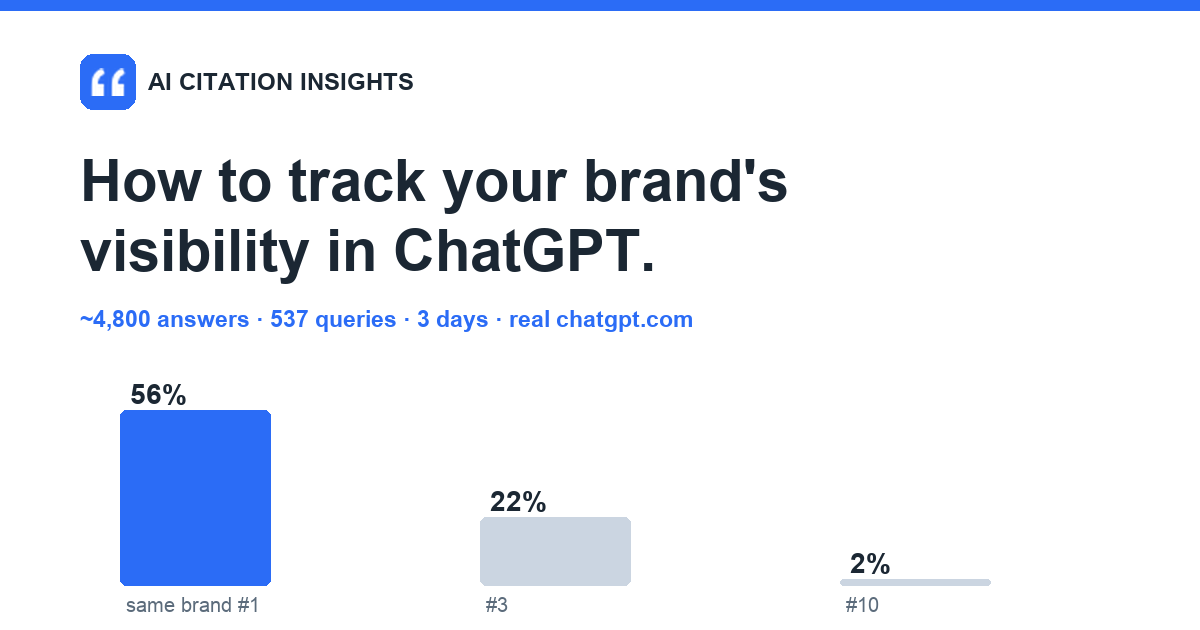
The same brand holding first place across all of a day’s runs happened 56% of the time. For third place it was already 22%, and for tenth just 2%. In other words, “you’re #4 in ChatGPT” isn’t a metric — you just got lucky that run.
2. The top 3 is the core; below it is a lottery
Roughly two brands hold steady in every run; the third slot is roulette. A fully identical top 3 showed up in only one query out of four.
3. Measure the cluster, not the query
Take “best paid search agencies”, three runs in a row:
- KlientBoost, Disruptive Advertising, HawkSEM
- KlientBoost, Disruptive Advertising, JumpFly
- KlientBoost, Disruptive Advertising, WebFX
The third slot is different every time. Now take the whole cluster: 29 PPC-agency queries — “best ppc agency”, “google ads agency for small business”, “ppc agency for ecommerce”, “ppc agency for lawyers”, “best amazon ppc agency”, and so on. Count the share of queries where each brand lands in the top 3, across the three runs:
From run to run almost nothing changes. The randomness of individual answers cancels itself out — the average difference is about 5 percentage points.
So use a cluster of 20–30 queries (at 10 queries the share swings ±15–30 pp and tells you little). And in the report, don’t write “brand #3 for this query” — write “the brand is in the top 3 in 24% of the cluster’s queries, and at #1 in 8%.”
4. The API is not what your client sees
API ↔ real chatgpt.com, same queries: top 3 agrees only 31–51% of the time.
Real chatgpt.com ↔ itself a day later: agrees 51–78% of the time.
We ran the same queries through the API too. The API is simply a different picture — if your tracker pulls from the API, it is not measuring what your customer actually sees.
5. Visibility swings because of query fan-out
Before answering, ChatGPT breaks your query into several of its own search queries — that’s query fan-out. You don’t see it in the web interface, but a scraper does: on average about two searches per answer.
Within a single day those searches mostly repeat (75–83%). Across different days they overlap only 53–62%. Change the fan-out, change the pages found, change the top 3. So the more pages that mention your brand, the more consistently ChatGPT names you.
Takeaways
- Track the real chatgpt.com, not the API — check how your tracker collects data, because the API’s top 3 matches real ChatGPT only 31–51% of the time.
- Use 20–30 queries per cluster.
- Report the share in the top-3 core and the share of runs at #1, not raw position.
- Collect the pages through which your brand enters the answer — that’s where your action plan already is.
📊 537 commercial queries (219 SaaS · 158 agencies · 160 consumer) · gpt-5-6 · US · English · 3 runs/day × 3 days ≈ 4,800 answers · real chatgpt.com with an API cross-check.
Get the next one in your inbox
One data-backed read a week on how AI names brands. No spam.