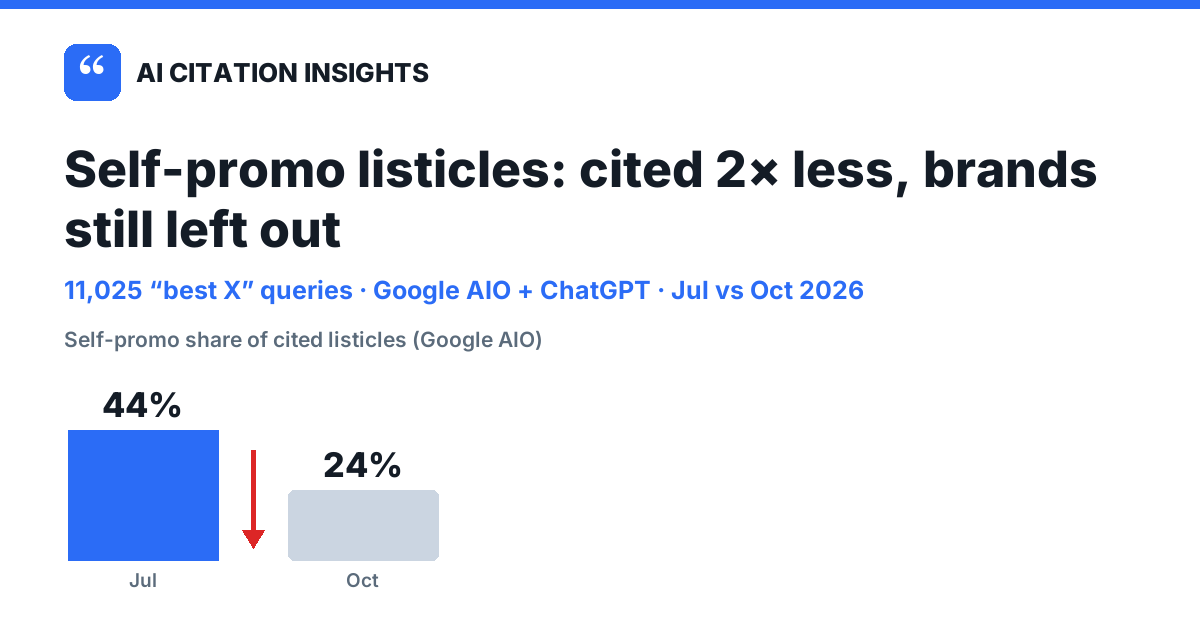
Google AI Overviews used to lean on self-promotional “best X” listicles. Not anymore.
In October 2026, AI Overviews cited them about half as often as they did in July.
And here’s the part that stings: when an AI does cite one, the brand that ranked itself #1 rarely ends up near the top of the answer.
We didn’t spot this first. Lily Ray did.
On 100 B2B software queries, her follow-up found AI Overviews citing 38% fewer self-promotional listicles than in June.
So we asked a simple question: does it hold up across other industries? We ran it on our full dataset of 11,025 commercial “best X” queries.
The dataset. 11,025 commercial “best X” queries across SaaS, finance, insurance, legal, home services, marketing and more. Google AI Overviews and ChatGPT, US, July and October 2026. Every cited page was crawled and labelled by an LLM: is it a listicle, does the publisher list itself, and in what order are the brands listed.
Google is citing far fewer self-promo listicles
The shift is hard to miss.
In July, self-promotional listicles made up 44% of the listicles Google AI Overviews cited.
By October? Just 24%.
And the drop is steeper than it looks.
Google cites fewer listicles across the board. But self-promotional ones fell much faster.
Per AI Overview, citations to listicles dropped 38%. Citations to self-promotional listicles dropped 66%.
Same direction Lily found, now visible across 11k queries and a dozen verticals.
Cited doesn’t mean recommended
Getting cited sounds like a win. Usually, it isn’t.
When AI Overviews cited a brand’s own self-promotional listicle, the brand wasn’t named in the answer at all. That happened 64% of the time in July, and 61% in October.
And the ones that do slip through?
They rarely reach the top. Here’s how often the brand at #1 of a cited listicle lands in the answer’s top 3:
| Brand at #1 of a cited listicle | AIO, July | AIO, Oct | ChatGPT, July | ChatGPT, Oct |
|---|---|---|---|---|
| Ranked itself #1 (self-promo) | 25% | 25% | 48% | 35% |
| #1 of a third-party listicle | 45% | 48% | 58% | 64% |
On Google, the gap barely moved. In both months, a self-ranked #1 made the top 3 about half as often as a third-party #1.
Google cites these pages less now. And among the answers that still cite one, the self-ranking publisher is less likely to reach the top 3 than a third-party listicle’s #1.
ChatGPT? Same story, and the gap is wider in October than in July.
So is AI punishing self-promotion?
Not really. These self-ranked #1s are mostly smaller brands. Their sites have about 4× fewer referring domains, and other listicles mention them about half as often. Compare the same brand as #1 on its own listicle versus #1 on someone else’s, and the gap shrinks to about 5 points and isn’t statistically significant. The AI isn’t penalizing self-promotion. A self-made listicle just can’t make a small brand look big.
A note on the comparison. Our July ChatGPT data comes from the API and October from chatgpt.com, which runs a newer model. Part of the July-to-October change on ChatGPT reflects the product, not only time.
ChatGPT cites them readily, but that buys little
ChatGPT is more generous. It pulls a set of pages for each query, then cites some of them.
And among the listicles it retrieved in October, it cited self-promotional ones far more often than third-party ones. Even after we excluded queries that name the publisher.
So does a cited self-promo listicle actually help the brand?
We put it to the test.
We ran 537 queries through chatgpt.com a dozen times each. Then, within the same query, we compared the same brand in runs where its own listicle was cited against runs where it wasn’t.
The result?
Within the same query, citing a brand’s own listicle was associated with the brand being named about 10 percentage points more often, and reaching the top 3 about 5 to 8 points more often.
And being named #1? Almost no change.
That’s an association, not proof the citation caused it, and it doesn’t tell us the order in which ChatGPT chose the brand and its source.
A small edge, then. Not a route to the top of the answer.
Two platforms, one lesson
- Google: cites self-promo listicles about half as often as in July.
- ChatGPT: cites them readily, but ranking yourself #1 doesn’t carry the weight of a #1 on someone else’s listicle.
- Both: the self-ranking publishers that slip are mostly smaller brands. A list you own can’t fake the authority a list you don’t own lends you.
If your AI visibility leans on your own “Best X tools” page, it’s doing less than it looks. The real work happens on lists you don’t own.
📊 11,025 commercial “best X” queries · SaaS, finance, insurance, legal, home services, marketing and more · Google AI Overviews + ChatGPT · US · July vs October 2026 · every cited page crawled and LLM-labelled · July ChatGPT data via the API, October via chatgpt.com · repeat test: 537 queries × ~12 runs on chatgpt.com. Context: Lily Ray’s study.
Get the next one in your inbox
One data-backed read a week on how AI names brands. No spam.